High Yield CD Calculator (APY & Yield)
Discover the true potential of your savings. Our powerful calculator instantly projects the future Final Maturity Value and Total Interest Earned on your high-yield Certificate of Deposit.
Calculate Your Certificate of Deposit Returns
Your Projected CD Returns
Total Interest Earned
$0.00
Final Maturity Value
$0.00
Growth Breakdown
Avg. APY %
Term (Years)
Compounding
Total Growth
Yearly Breakdown Table
| Year | Starting Balance | Interest Earned | Ending Balance |
|---|
CD APY Calculator: Understanding APY Before You Invest
When you use a CD APY calculator, the number that matters most is not the interest rate. It is the Annual Percentage Yield (APY). APY reflects the real return on your deposit after compounding is applied, which is why two CDs with the same advertised rate can produce noticeably different results depending on how often interest compounds.
For example, a CD with a 5.00% nominal rate compounded daily will yield more than one compounded monthly over the same term. A CD APY calculator for CDs captures that difference automatically, so you always see your true projected earnings, not just the advertised number.
Here is what APY actually measures:
- Nominal Rate: the base interest rate the bank advertises
- Compounding Frequency: how often interest is added to your balance (daily, monthly, quarterly)
- APY: the effective annual return after compounding is fully applied
Our CD APY calculator above handles all of this automatically. Enter your deposit amount, term length, and rate. You will instantly see your APY-adjusted return alongside your total interest earned and final maturity value. No spreadsheets, no manual math.
Want to find the best APY to plug in? Browse today’s highest-yielding options on our Top CD Rates page and compare real offers from leading online banks and credit unions.
What is the Difference: Interest Rate vs. CD Yield (APY)?
Most banks advertise the Interest Rate, but you actually earn the Yield (APY). The difference comes from compounding frequency.
| Feature | Interest Rate | CD Yield (APY) |
|---|---|---|
| Definition | The simple annual percentage. | The total amount you actually earn. |
| Includes Compounding? | No (Simple Interest) | Yes (Compound Interest) |
| $10k Deposit Example | 5.00% Rate = $500 | 5.13% Yield = $513 |
*Example assumes Daily Compounding. Use the CD Yield Calculator above to see your exact return.
CD Projection: See Exactly What Your Deposit Grows To
A CD projection shows you precisely how much your deposit will be worth at maturity, broken down by interest earned and final balance. Unlike a regular savings account where balances shift constantly, a CD locks in your rate for the full term, making accurate projections straightforward and reliable.
Use the CD projection calculator above to model your deposit in seconds. Here is what each input controls:
💵 Principal
Your starting deposit amount, which is the base on which all interest is calculated.
📈 APY / Rate
The annual percentage yield offered by the bank. Use APY, not the nominal rate, for accurate projections.
📅 Term
The length of the CD in months or years. Longer terms generally offer higher rates.
🔁 Compounding Frequency
How often interest is credited. Daily compounding yields slightly more than monthly or quarterly.
Once you calculate, you’ll see your projected maturity value and total interest earned, the two numbers that matter most when comparing CD offers side by side. For longer terms, even a 0.25% difference in APY compounds into a significant dollar amount over time.
Ready to find a rate worth projecting? Visit our CD Rates page to see which banks are offering the highest APYs today across all major term lengths.
Why 2026 Is a Critical Window for Locking In a CD Rate
CD rates are falling. Not crashing, but falling steadily, and the direction is clear.
The Federal Reserve cut its benchmark rate three times in late 2025, bringing the federal funds rate down to 3.50% to 3.75%. Every time the Fed cuts, banks adjust what they pay on new CDs. Rates that were sitting above 5% in 2023 are now mostly in the 3.75% to 4.25% range at competitive online banks. The FDIC March 2026 national averages tell the rest of the story: the average 12-month CD pays just 1.52% APY. That is what most people at traditional banks are actually getting right now.
The gap between what is available and what most people accept is significant. The best 12-month CD available as of April 2026 was paying 5.11% APY. On a $20,000 deposit held for one year, the difference between that rate and the national average works out to roughly $718 in extra interest. Gone, simply by not shopping around.
Here is what makes 2026 different from previous years. When rates were rising, waiting made sense. You could open a CD today and find a better one three months from now. That logic no longer works. The Fed’s own projections point toward additional cuts later in 2026, and most bank economists expect at least one more reduction before the end of the year. The rates available today are likely to be the best you will find for a while.
This is not a call to panic. It is math. Use the calculator above to model what your deposit earns at today’s rate versus what it earns at a rate that is 0.25% or 0.50% lower. The difference compounds over a 2-year or 3-year term in ways that are not obvious until you run the numbers.
Next Fed Meeting: April 28 to 29, 2026
Whatever is decided will ripple into new CD rates within days. See current top rates on our CD Rates page before then.
The Real Cost of Waiting: What Delay Actually Does to Your CD Return
Most people know that higher APY means more interest. Fewer actually calculate what waiting costs them in dollars, and the number tends to be larger than expected.
A concrete example using current market data:
| Scenario | Deposit | APY | Term | Total Interest |
|---|---|---|---|---|
| Today’s rate | $25,000 | 4.00% | 2 years | $2,040.40 |
| After one 0.25% cut | $25,000 | 3.75% | 2 years | $1,908.55 |
| Cost of waiting | $131.85 less | |||
| Today’s rate | $25,000 | 4.00% | 5 years | $5,204.94 |
| After one 0.25% cut | $25,000 | 3.75% | 5 years | $4,872.81 |
| Cost of waiting | $332.13 less |
The point is not that $131 will change your life. The point is that this is the real, dollar-specific cost of hesitation, and most savings content never shows it this directly. The wait and see instinct costs real money, and that cost scales with your deposit size.
The Federal Open Market Committee’s next scheduled meeting is April 28 to 29, 2026. Whatever they decide will ripple into new CD rates within days. Locking in before a rate decision is a specific, time-sensitive move, not vague advice to act now.
Use the calculator above to run this comparison for your own deposit. Enter your amount at today’s rate, then drop the APY by 0.25% and recalculate. The difference in your results is what waiting could cost you in concrete dollars.
Find the best rate available right now on our CD Rates page.
Ready to Find Your Rate?
Now that you’ve projected your earnings, browse our curated list of the best APYs available from top online banks.
View Top CD Rates →Understanding High Yield Certificates of Deposit (CDs)
Saving money today is not just about setting funds aside. It is about choosing the right financial tools that help your balance grow steadily and safely over time. High Yield Certificates of Deposit (CDs) have become one of the most trusted options for people who want predictable growth, guaranteed returns, and zero exposure to market volatility. Our High Yield CD Calculator is designed to make this process easier by showing you exactly how your money grows, how compounding works behind the scenes, and how different terms and APYs affect your long-term financial results.
Whether you’re new to CDs or already familiar with deposit accounts, everything below covers what you need to make smarter financial decisions.
Why High Yield CDs Matter in Today’s Economy
Economic uncertainty has pushed many individuals toward safer investment options. Unlike investments tied to the stock market, a CD provides guaranteed interest, FDIC-insured security, and predictable returns. Many high-yield CDs offer significantly better rates than regular savings accounts, especially those from online banks and credit unions.
With interest rates fluctuating frequently, having a tool that gives you precise, instant projections is more important than ever. A small difference in APY or compounding frequency can dramatically change your final maturity value over 5 or 10 years.
How CD Compounding Works: The Math Behind the Growth
Most people assume that CD earnings depend only on APY. In reality, compounding is what makes your balance grow faster. Compounding means your interest earns more interest every month, quarter, or year.
How to Use This Calculator
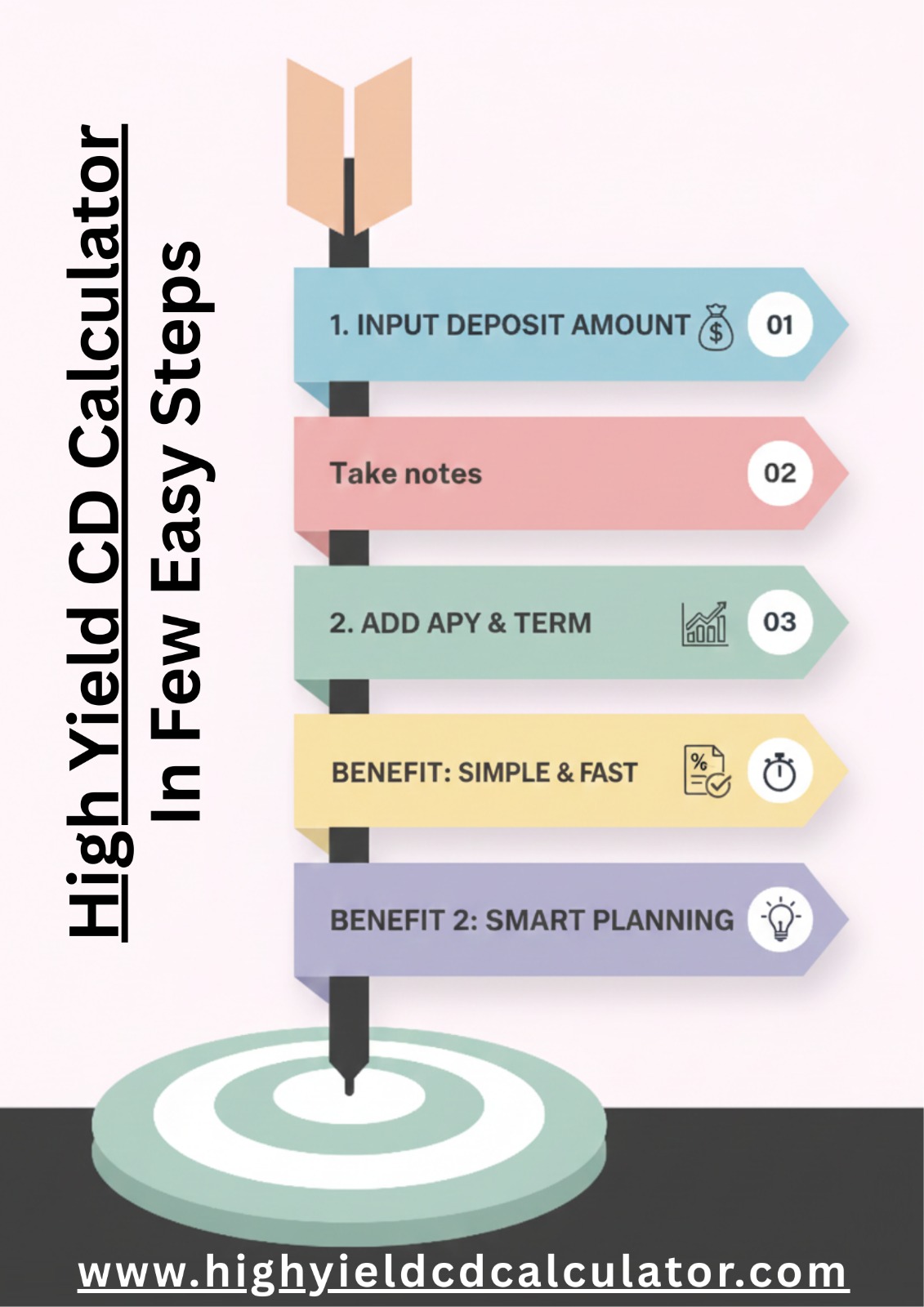
Visualize your financial trajectory with this growth analysis infographic. It illustrates how an initial deposit grows over time through compounding, showing the distinct breakdown between your principal, total interest earned, and final maturity value.
For example, if you invest $10,000 at 5.00% APY for 5 years:
- Simple Interest: You would earn exactly $2,500 ($500 per year).
- Compound Interest: With monthly compounding, your balance increases every period because interest is added to the principal before the next calculation, resulting in meaningfully more at maturity.
Our calculator uses the precise formula A = P(1 + r/n)^(nt) to ensure every cent is accounted for.
Tax Implications: What to Know Before You Earn
Interest earned on standard CDs is generally considered taxable income in the year it is added to your balance, even if you do not withdraw it. At the end of the year, your bank will typically send a Form 1099-INT showing your earned interest.
Individuals in higher tax brackets sometimes hold CDs inside tax-advantaged accounts such as IRAs, where interest may grow tax-deferred until retirement. Always consult a tax professional for advice specific to your situation.
Inflation and Real Rate of Return
When evaluating CD rates, consider inflation. If a CD pays 5% APY but inflation is running at 3%, your real rate of return is closer to 2%. High Yield CDs are excellent vehicles for low-risk, predictable growth, though understanding inflation helps you choose the right terms for long-term financial goals.
How to Calculate CD Yield Manually, Step by Step
Knowing how to calculate CD yield manually gives you complete transparency into what any CD is actually worth, and lets you verify the numbers a bank presents before you commit your funds. There are two formulas worth understanding depending on the CD type.
Formula 1: Compound Interest (used by most CDs)
- A = Final maturity value
- P = Principal (your deposit)
- r = Annual interest rate as a decimal (e.g. 5% = 0.05)
- n = Compounding periods per year (daily = 365, monthly = 12)
- t = Term in years
Example: $10,000 at 5.00%, compounded monthly, for 1 year:
A = 10,000 × (1 + 0.05/12)^(12×1) = $10,511.62. Total interest: $511.62
Formula 2: Simple Interest (used by some short-term CDs)
Example: $10,000 at 5.00% for 6 months (0.5 years):
I = 10,000 × 0.05 × 0.5 = $250.00
How to Calculate Annualized CD Yield
To compare a short-term CD to a longer one on equal footing, use the annualized yield formula:
This is especially useful when comparing 3-month or 6-month CDs against 1-year or 2-year options side by side.
Rather than doing this manually every time, the High Yield CD Calculator above delivers instant, accurate results for any deposit, rate, and term combination. For today’s top rates to plug into any formula, visit our Best CD Rates page.
CD Laddering Strategy: Maximize Yield Without Locking Up All Your Cash
A CD ladder is a strategy where you split your total deposit across multiple CDs with staggered maturity dates, typically 1-year through 5-year terms. As each CD matures, you reinvest into a new long-term CD, keeping your money working at the highest available rates while maintaining regular access to a portion of your funds each year.
Why a CD ladder works:
- ✓ Liquidity: One CD matures every year, giving you cash access without early withdrawal penalties.
- ✓ Rate capture: Each maturing rung becomes a reinvestment opportunity, especially valuable when rates rise.
- ✓ Flexibility: You’re never fully locked into a single rate or term.
Example: $25,000 split across a 5-rung CD ladder
| Rung | Amount | Term | Matures In |
|---|---|---|---|
| 1 | $5,000 | 1 Year | 12 months |
| 2 | $5,000 | 2 Years | 24 months |
| 3 | $5,000 | 3 Years | 36 months |
| 4 | $5,000 | 4 Years | 48 months |
| 5 | $5,000 | 5 Years | 60 months |
Each year, one rung matures and you reinvest at the prevailing 5-year rate, gradually shifting your entire ladder toward higher long-term yields. To model each rung individually, use the CD calculator above and enter each deposit and term separately to see the projected maturity value per tranche.
Building a ladder starts with finding the best rate for each rung. See today’s top offers across all major term lengths on our Top CD Rates page.
Disclaimer: This tool is for educational and informational purposes only. While we strive for accuracy, CD terms, rates, and compounding schedules vary by institution. Always verify the APY and full terms directly with your financial institution before depositing funds. This is not financial advice. See our About page and Privacy Policy for more information.
Frequently Asked Questions
The interest is calculated using the compound interest formula: A = P × (1 + r/n)^(nt). Our calculator uses the initial deposit (P), the Annual Percentage Yield (r), the compounding frequency (n), and the term length (t) to determine your final maturity value and total interest earned.
The Annual Percentage Yield (APY) is the effective annual rate of return including the effect of compounding. The Interest Rate (or nominal rate) is the stated rate before compounding is applied. When comparing CD offers, APY is the most important number because it reflects the true amount you will earn.
Yes. CDs penalize you for withdrawing funds before the maturity date. The penalty is typically a forfeiture of several months’ worth of interest. Always verify the exact penalty structure with your financial institution before opening a CD. Only No-Penalty CDs allow early withdrawal without a fee.
CD laddering is a savings strategy where you divide your deposit across multiple CDs with different maturity dates, for example, 1-year, 2-year, 3-year, 4-year, and 5-year CDs. As each CD matures, you reinvest at the best available rate. This gives you both the higher yields of long-term CDs and periodic access to your funds without paying early withdrawal penalties.
Yes, in most cases. Interest earned on a CD is generally taxable as ordinary income in the year it is credited to your account, even if you do not withdraw it. Your bank will typically issue a Form 1099-INT at year-end. If your CD is held in a tax-advantaged account such as an IRA, different rules may apply. Consult a tax professional for advice specific to your situation.